Diving can be classified as either open circuit or closed circuit depending on the type of breathing apparatus used. While the former is most common, advanced divers often switch to a closed-circuit breathing apparatus. Regardless of your skill level, though, you might be wondering how they differ from each other. Today, we’re going to take a closer look at open-circuit and closed-circuit diving, revealing the unique characteristics and benefits of each method.
What Is Open-Circuit Diving?
 Open-circuit diving involves the use of a traditional breathing apparatus, known as a regulator, in which no gas is recycled. Most divers use a gas mixture consisting of 21% oxygen, 78% nitrogen and 1% other gases (e.g. argon). Other divers use a gas mixture consisting of more than 21% oxygen. Regardless, in open-circuit diving, divers don’t recycle any of the gas they breathe.
Regulators used in open-circuit diving aren’t designed to recycle or reuse gas. The gas is stored in a tank. When you inhale through the regulator, the gas travel will travel from the tank to your regulator. When you exhale, the gas will typically be released into the surrounding sea. The only exception is if you are wearing a buoyancy control device (BCD), in which case the gas may be transferred to the wearable BCD to increase your buoyancy.
The defining characteristic of open-circuit diving is that no breathing gas is recycled. It goes from the tank into your lungs, and when you exhale, it’s either released into the surrounding sea or transferred to your BCD.
What Is Closed-Circuit Diving?
Closed-circuit diving, on the other hand, involves the use of a rebreather, as well as other equipment, that recycles some or all of the breathing gas. Rebreathers contain a mouthpiece through which you inhale and exhale while underwater. When you inhale, gas will travel from your tank to your mouthpiece — just like it does with open-circuit regulators. When you exhale, however, gas doesn’t go into the surrounding sea. Instead, it’s transferred back into your tank so that you can reuse it.
A rebreather is more than just a mouthpiece; it’s an entire system used to provide and recycle breathing gas. Exhaling through the mouthpiece of a rebreather sends the gas in your lungs to a rebreather component known as a carbon dioxide scrubber. Here, the scrubber removes carbon dioxide from the gas before sending it to the counterlungs.
A typical closed-circuit rebreather consists of the following components:
- Mouthpiece: The mouthpiece, of course, is a component through which you inhale and exhale. Like other mouthpieces, you wear it by biting down on the top and bottom with your teeth.
- Hoses: Rebreathers have several hoses that are used to provide the diver with gas and recycle the diver’s used gas. They are typically made of durable but flexible synthetic rubber. Rebreather hoses connect the mouthpiece to other components like the tank and counterlungs.
- Counterlungs: Another essential rebreather component is the counterlungs. The counterlungs assist divers with inhaling and exhaling gas by maintaining the same pressure as the diver’s lungs (tidal volume).
- Carbon Dioxide Scrubber: As mentioned earlier, the carbon dioxide scrubber is a component of a rebreather that’s designed to remove carbon dioxide from the gas exhaled by the diver. When you exhale, you won’t breathe out the same amount of oxygen that you inhaled. Rather, you’ll breathe out more carbon dioxide and less oxygen. This is because our bodies run on carbon-based sources of energy. To remove carbon dioxide from exhaled gas, rebreathers use a carbon dioxide scrubber.
- Over-Pressure Valve: While not used in all rebreathers, some closed-circuit breathing apparatuses feature an over-pressure valve. Mounted on the counterlungs, the over-pressure valve allows the diver to release gas in the breathing circuit when he or she is ascending. If gas remains trapped in the circuit, ascending will cause the gas to expand and, therefore, increase the risk of critical equipment failure.
- Gas Tank: All rebreathers must have a gas tank in which the breathing gas is stored.
The defining characteristic of closed-circuit diving is that some or all of the breathing gas is recycled. This is in stark contrast to open-circuit diving, in which no breathing gas is recycled.
Benefits of Open-Circuit Diving
For beginners, open-circuit diving is always recommended because of its simplicity. An open-circuit regulator is simple and easy to use. You don’t have to worry about components like the carbon dioxide scrubber or over-pressure valve failing, nor do you have to worry about maintaining or replacing those components. As a result, it’s a safer choice for beginners to the sport of diving.
Another benefit of open-circuit diving is its low cost of equipment. Open-circuit regulators are inexpensive, with some models costing just $200. In comparison, rebreathers are much more expensive. It’s not uncommon for rebreathers to cost over $5,000. This is because rebreathers contain more parts than regulators.
Benefits of Closed-Circuit Diving
Although it’s more complex and difficult than open-circuit diving, closed-circuit diving offers several advantages, one of which is an increased bottom time. According to a study published in the Marine Technology Society Journal, closed-circuit divers consume 17 times less gas than open-circuit divers. With the gas being recycled, closed-circuit divers can stay underwater longer than their open-circuit counterparts.
A rebreather system may cost more than a traditional open-circuit regulator, but don’t let that fool you into thinking closed-circuit diving is more expensive. The same study cited above found that closed-circuit divers spend seven times less money on gas and other “expendables” than open-circuit divers.
There are also certifications you can take to improve your proficiency in closed-circuit diving. The Professional Association of Diving Instructors (PADI), for example, offers the Rebreather Diver Course. If you’ve passed the PADI Open Water Diver Course and the PADI Enriched Air Diver Course, you can enroll in this course, assuming you are at least 18 years old and have 25 or more logged dives. This comprehensive course will teach you the mechanics of closed-circuit diving, including how to check your rebreather equipment, how to perform bubble checks, optimizing your BCD, monitoring gauges and more.
In addition to the PADI Rebreather Diver Course, Technical Diving International (TDI) offers the Closed Circuit Rebreather (CCR) Air Diluent Diver Course. To enroll in the TDI CCR Air Diluent Diver Course, you’ll need to have certification in the TDI Nitrox Diver Course, be 18 years of age or older and have a minimum of 20 logged dives. In this course, you’ll learn about the history of breathers, how they compare to open-circuit regulator, dive tables, equipment procedures and more. Enrolling in a closed-circuit diving course like the PADI Rebreather Diver Course or the TDI CCR Air Diluent Diver Course requires an investment of both your time and money, but it can help you become a better, safer closed-circuit diver.
The Bottom Line on Open-Circuit and Closed-Circuit Diving
 Diving requires the use of a breathing apparatus that transfers gas to a mouthpiece. In open-circuit diving, the regulator doesn’t recycle any of the used gas. In closed-circuit diving, the rebreather recycles some or all of the used gas.
Both open-circuit and closed-circuit diving offer their own unique advantages. Beginners, however, should always start with open-circuit diving because of its simplicity. Only after mastering the use of an open-circuit regulator should you consider closed-circuit diving.
Want to create your own custom dive logs? Contact us today to learn more about our custom dive logs.
 Also known as a scuba mask, a dive mask is a piece of wearable diving equipment that’s used primarily to improve vision while underwater. When worn, it covers both your eyes and nose. Without a dive mask, your eyes will be exposed to the saltwater (or freshwater, depending on where you are diving). And because exposure to water prevents light from focusing on the retina of your eyes, you won’t be able to see very well.
 When all else fails, consider switching to a full-face dive mask. Full-face dive masks cover your entire head, and many of them feature a drain valve that’s designed specifically to remove water. Just engage the drain valve, at which point water will flush out the mask. Some full-face dive masks even have an automatic clearing function in which you tilt or raise your head to remove water. Full-face dive masks are larger and bulkier than traditional dive masks, but they are less likely to flood with water than their counterparts.
 While most divers know not to touch corals, many assume that it’s okay to walk on the ocean floor if there are no corals growing on it. The problem with walking on the ocean floor around corals, however, is that it stirs up sediment, which eventually lands on corals. Corals are porous, consisting of a honeycomb-pattern of small holes in which algae lives. If you walk along the bottom of the ocean floor next to a coral, some of the sand and sediment will coat the coral and clog its pores. When this happens, algae won’t be able to make its way inside the coral. And because algae is the main source of food (energy) for corals, this often leads to bleaching and eventually the death of corals.
 Assuming this is your first time diving around a particular coral reef, you should spend some time researching the local marine life. No two coral reef systems have the exact same species of marine life. If it’s your first time diving at a coral reef, you’ll encounter a myriad of unfamiliar marine species. By researching the coral reef’s marine life, though, you’ll a better idea of what to expect.
 People have been diving alone for thousands of years. In Ancient Mesopotamia, archeological evidence shows that fishermen would dive alone to spearfish and collect oysters. The Greek poet Homer even referenced the act of solo diving in several of his poems, which are believed to have been published in the 6th to 8th century B.C. It wasn’t until the mid-1900s, however, when the buddy system was introduced to promote safer diving.
 Although there are plenty of reasons to consider solo diving, there are still some disadvantages worth mentioning. Without a buddy, the risk for injury or even death is greater if you experience a health event when solo diving. According to
 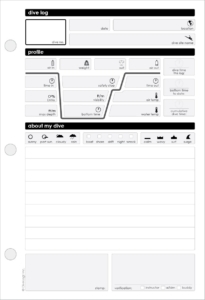 A dive log is a document detailing the conditions and events of a single, specific dive. It features various fields that you can complete to record your diving experience. While different dive logs have different fields and formatting, they all serve the same underlying purpose of recording your dives. When you go diving, you should complete a dive log to create a journal of your experience.
 Unless you’re a professional diver, you aren’t legally required to use a dive log. However, it’s still a good idea to use dive logs because it creates a record of your past dives. No two dives are ever the same, and without dive logs, you may struggle to remember key information about your past dives.