
With their distinct hammer-shaped head, hammerhead sharks are some of the most recognizable fish in the oceans. Unlike most other sharks, they don’t have a traditional head. Rather, hammerheads have an elongated and flattened head that extends out to their right and left sides. If you’re an avid diver who appreciates the unique beauty of these sharks, you might be wondering where to find them. While hammerheads are native to a variety of aquatic regions, there are a few steps you can take to increase your chances of encountering them when diving.
What Are Hammerhead Sharks?
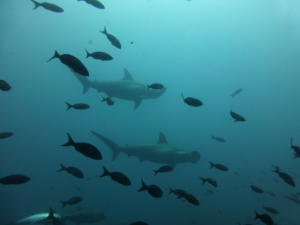 Before we reveal where to find hammerheads, let’s take a closer look at this majestic shark. Contrary to what some divers believe, the hammerhead isn’t a specific species of shark. Rather, the term “hammerhead” refers to any shark featuring a characteristically hammer-shaped head. Most hammerheads are in the Sphyrna genus, though some are categorized in a different genus. The winghead hammerhead, for example, is placed in the Eusphyra genus.
Marine biologists believe that hammerhead sharks have their hammer-head shapes for increases sensory reception. The general belief is that their hammer-shaped head allows these sharks to hunt prey more easily, which certainly makes sense. Regardless, you can easily distinguish hammerheads from other types of sharks by looking at their head. If it’s elongated and flattened, it’s a hammerhead.
Here are some fun facts about hammerheads:
- While most hammerheads have a gray body, their bellies are white to provide camouflage when viewed from below.
- During the daytime hours, hammerheads often swim in large groups of up to 100 or more. During the evening and nighttime hours, they swim alone so that they can hunt prey more effectively.
- Hammerheads have evolved over the course of some 20 million years. Marine biologists believe that modern-day hammerheads are descendants of the ancient Miocene shark.
- The average length of a full-growth adult hammerhead is approximately 5 to 20 feet.
- Hammerheads can grow quite large, with some hammerheads weighing as much as much 1,300 pounds.
- With their hammer-shaped head, hammerheads have a complete 360-degree field of vision, allowing for superior sensory reception when compared to other types of sharks.
- Hammerheads mate once a year.
- A typical diet for a hammerhead consists of fish, octopus, shrimp, stingrays and even other sharks.
- When a hammerhead attacks a stingray, it will use its head to pin the stingray down against the bottom of the ocean floor.
- The average litter size of a hammerhead is approximately 12 to 15 pups. Some hammerheads, however,m have been known to give birth to up to 40 pups.
- Hammerhead pups typically swim together until they are large enough to survive on their own.
- There are nine species of hammerhead sharks, each of which has a distinct appearance.
- No human fatalities by a hammerhead have ever been recorded.
- The average lifespan for a hammerhead is roughly 25 to 35 years.
- Hammerheads are known to perform mass migrations during the summer.
- Bonnethead hammerheads have been known to consume a substantial amount of seagrass. According to some studies, up to half of a bonnethead hammerhead’s diet may consist of seagrass.
- Hammerheads are some of the ocean’s most adept predators, primarily because of their high sensory reception attributed to their hammer-shaped head.
- Like with other sharks, hammerhead teeth are often found as fossils.
- Hammerheads are considered “gods of the ocean” in Hawaii.
How Common Are Hammerhead Sharks?
When compared to other types of sharks, hammerheads are somewhat rare. The most common type of hammerhead is the bonnethead. Unfortunately, though, the International Union for Conservation of Nature (IUCN) has listed several types of hammerheads as vulnerable, including the smalleye and smooth hammerhead. The scalloped hammerhead and winghead hammerhead have even been given the endangered status, attesting to their rarity.
Where to Find Hammerhead Sharks When Diving
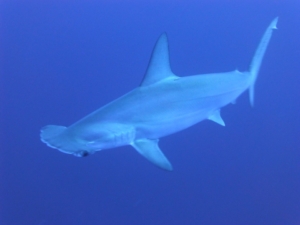 Although hammerheads are somewhat rare, you can still find them when diving — you just need to know where to look. Hammerheads thrive in warm and shallow coastal waters. You typically won’t find them far north or south, nor will you find them in hundreds or thousands of miles away from the coast. Rather, all nine species of hammerheads prefer warm and shallow coastal waters. So, if you’re hoping to encounter a hammerhead, you’ll need to choose a dive site that’s located in shallow, warm waters near a coast.
Costa Rica is a popular destination for divers looking to encounter hammerheads. Specifically, large groups of hammerheads are often found in the waters surrounding Costa Rica’s Cocos Island. Located roughly 342 miles southwest of Costa Rica’s main island, it features rich coral reefs off the coast. Marine biologists, in fact, have identified over 30 species of coral reefs native to Coco Island’s waters. The coral reefs attract a variety of fish, as well as other marine life, that are commonly consumed by hammerheads.
Another destination where you’ll have a good shot at encountering hammerheads is the waters off the coast of Hawaii. Oahu Island’s Keehi Lagoon, for example, contains large schools of scalloped hammerheads. Scalloped hammerheads are endangered, so you probably won’t see them elsewhere.
In addition to Costa Rica and Hawaii, other coastal waters frequently inhabited by hammerheads include Columbia, South Africa and Ecuador. Keep in mind, though, that hammerheads often migrate to cooler waters during the summer. As a result, you may want to plan your hammerhead-searching dive trip for the early or late summer months.
How to Stay Safe When Diving Around Hammerhead Sharks
While the thought of diving around sharks may sound unnerving, you can rest assured knowing that hammerheads are docile. According to the International Shark Attack File — a global database that records and manages instances of shark attacks — there have only been 17 documented cases in which a hammerhead has attacked a person without provocation. Considering that millions of people swim and dive in the waters where hammerheads call home, that’s pretty impressive. And as previously mentioned, no one has ever been killed by a hammerhead.
With that said, there are still a few rules you should follow when diving around hammerheads to lower your risk of injury. First and foremost, never attempt to touch a hammerhead (or any other shark for that matter). You should also pay attention to your gas supply. When you’re busy marveling a large group of passing hammerheads, you may overlook your gas supply. As a result, you’ll consume a significant amount of gas without realizing it. Regardless of where you are diving, try to get into the habit of checking your gas supply at least once every five to 10 minutes.
You may also want to avoid diving at night. Hammerheads are nocturnal predators that hunt for prey at night. Therefore, they are more aggressive during the nighttime hours than the daytime hours. Of course, another reason to dive during the daytime is because hammerheads swim in large groups during the daytime. At nighttime, on the other hand, they become more solidarity. For these reasons, it’s best to dive for hammerheads during the daytime.
Express your love for this majestic shark by purchasing a hammerhead dive log book today! Featuring a hammerhead shark on the cover, it offers 50 high-quality dive log pages that you can use to record and document your dives. Each hammerhead dive log book is individually wrapped in a poly sleeve to protect your dive logs from damage.
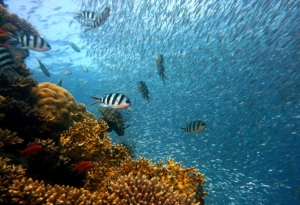 Taking photos of fish can certainly help, but you should also observe their behaviors. Like with other animals, different types of fish exhibit different behaviors. Groupers, for example, are solitary fish that prefer traveling alone. As a result, you typically won’t see them swimming together. Flounders, on the other hand, stay at or near the ocean floor where they hunt for other small fish or shrimp to eat. Flounders are also very skittish. If you approach a flounder while diving, it will probably skitter in the opposite direction while kicking up a cloud of sediment in its wake.
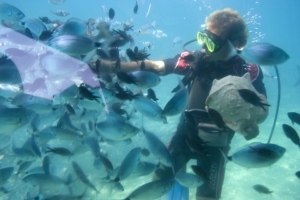 There are books available that can help you identify fish. Known as a fish identification book, it’s an invaluable resource for serious divers. The Caribbean Reef Life Fish ID Book sold here at Dive Logz contains hundreds of reef-dwelling fish. In this fish identification book, you’ll find descriptions of fish as well as their growth patterns, life stages and more.
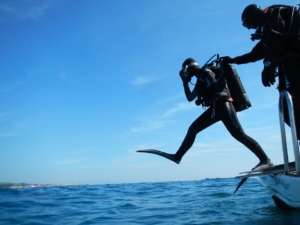
 When first stepping onto the charter boat, choose a seat near the center rather the edge of the boat. Depending on where exactly you are diving, as well as the type of charter boat used, it may take an hour or longer to reach your dive site. Some divers prefer sitting on the edge so that they can look out at the ocean. If you sit near the edge of the boat, though, you may get splashed from rogue waves.
 If you’re planning to bring a dive log, you should store it in a water-resistant binder for maximum protection. Most divers leave their dive log on the charter boat, believing that it won’t get wet here. With charter boats surrounded by water on all sides, though, there’s always a risk for water exposure. And if your dive log gets wet, it could smear the ink and degrade the paper.
 Although it sounds like a meaningless skill, knowing how to communicate with other divers below the surface is important for several reasons. First, it allows you to convey potential hazards that could otherwise cause injury to either yourself or another diver. If you are running low on air, you can inform your buddy so that you can use his or her regulator. If you want to travel in a different direction, you can communicate this to your buddy so that he or she can follow you.
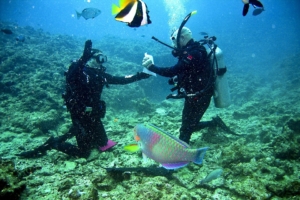 While not as effective as hand signals or a dive slate, lights can also be used to communicate when diving. A dive light is a special type of handheld flashlight that’s designed to illuminate your surrounding environment when diving. If you’re diving at night, you can use a dive light to increase your visibility. But dive lights are also an effective means of underwater communication.
 You can also use custom dive logs to educate customers about your business. When ordering custom look books, you can add pages with information about your business and what it offers. If your business’s diving instructors are PADI-certified, for example, you can mention this on the page. Of course, you can other information about your business in your custom log books, such as the type of diving equipment offered to customers, duration of dives and more. All of this information will help educate your audience about your diving business.
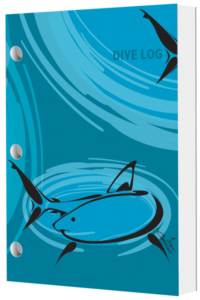 Custom log books support more than just basic dive logs. They are fully customizable, inside and out, and can even feature maps associated with your business’s dive sites. If your business has a half-dozen different dive sites, you can include a map of the surrounding beach or island with markers pinpointing the location of each of the six dive sites. With a map of the area, customers can see the location of your business’s dive sites simply by checking out your custom log books. Generic log books, on the other hand, don’t have any maps or pages of additional information. Rather, they consist entirely of log pages.
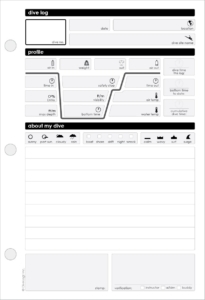 A dive log is a document detailing the conditions and events of a single, specific dive. It features various fields that you can complete to record your diving experience. While different dive logs have different fields and formatting, they all serve the same underlying purpose of recording your dives. When you go diving, you should complete a dive log to create a journal of your experience.
 Unless you’re a professional diver, you aren’t legally required to use a dive log. However, it’s still a good idea to use dive logs because it creates a record of your past dives. No two dives are ever the same, and without dive logs, you may struggle to remember key information about your past dives.