
Are you struggling to find the perfect gift for a diving enthusiast in your life? With the holidays right around the corner, you don’t much time to spare. However, that doesn’t mean you should settle on a restaurant or retail gift card. You can still leave a lasting impression by choosing the right gift. Below are seven awesome gift ideas for the diving enthusiast in your life.
#1) Water Socks
Also known as aqua socks, water socks are a great gift idea for a diving enthusiast. Like conventional socks, they are worn on the feet for warmth, comfort and protection from the elements. Water socks are unique, however, because of their waterproof construction. While conventional socks are typically made of organic materials like cotton or wool, water socks are made of synthetic waterproof materials like lycra or neoprene.
Because of their waterproof construction, water socks can be worn when diving. They are super soft and comfortable yet equally strong and durable. Keep in mind that diving socks are available in several different styles, so choose a style that matches the personal preference of the diving enthusiast for whom you are purchasing it.
#2) Diving Mask Defogger
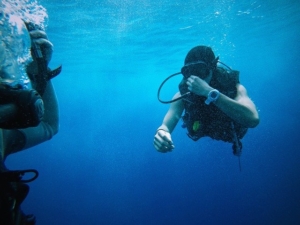
A diving mask defogger is the perfect stocking stuffer for a diving enthusiast. It’s frustrating when you’re diving 50 feet below the surface, only to discover that your mask is fogging up. This all-too-common phenomenon is the result of moisture vapor accumulating on the interior surface of a diving mask. As the moisture vapor builds up, it creates a cloudy haze that restricts your visibility. A diving mask defogger, as the name suggests, is a special type of product that’s designed to protect diving masks from fog-related problems such as this.
How do diving mask defoggers work exactly? While no two defoggers are the same, they all contain a proprietary blend of ingredients that lubricates diving masks to prevent the buildup of moisture vapor. Diving enthusiasts can spray the inside of their diving mask with the defogger, at which point he or she will experience better underwater vision when diving. Considering that defoggers are available for as little as $10, it’s an inexpensive and meaningful gift idea that’s bound to leave a lasting impression this holiday season.
#3) Dive Watch
Assuming he or she doesn’t already have one, you can give the diving enthusiast a dive watch this holiday season. Also known as a diving watch, a dive watch is a type of time-tracking wristwatch that’s designed specifically for underwater use. By definition, all dive watches can withstand the water, as well as the pressure, when diving at depths of at least 330 feet. With that said, most dive watches are designed for use at depths of up to 700 to 1,000 feet.
Here are some features to look for when shopping for a dive watch this holiday season:
- Dive time indicator
- High visibility in dark environments
- Resistance to magnetic fields
- Resistance to shock
- Resistance to chemicals
- End of life (EOL) indicator
- Adjustable wristband
- Attractive color and design
#4) Underwater Camera
In addition to a dive watch, an underwater camera is a great gift idea for a diving enthusiast. If you’ve ever dived before, you probably know that each dive is a unique experience. You’ll encounter a new and unfamiliar time each time you get in the water. With an underwater camera, a diving enthusiast can capture these experiences on film. Underwater cameras are designed to withstand the harsh underwater environments, allowing for crystal-clear images of a dive. A diving enthusiast can use the underwater camera to take photos of fish, coral reefs, submerged structures and more.
Underwater cameras can typically capture both images and videos. Videos, of course, consume more storage space than images. Therefore, you may want to purchase an extra memory card if the diving enthusiast for whom you purchase the underwater camera enjoys taking videos. The extra memory card will allow him or her to record more videos. Even without an extra memory card, though, an underwater camera is a meaningful gift for a diving enthusiast.
#5) Diving Lessons
A diving lesson is the gift that keeps on giving. While generic gift cards are typically a poor choice for a gift, an exception of a gift card for diving lessons. The Professional Association of Diving Instructors (PADI) offers gift cards for all of its online courses. Known as PADI eLearning Gift Passes, they allow a diving enthusiast to take his or her diving skills to the next level. Using the eLearning Gift Pass, the diving enthusiast can participate in a specific PADI course. Assuming he or she completes the course, the diving enthusiast will receive PADI certification. You can even customize your eLearning Gift Pass to feature a festive holiday design as well as a personal message to the recipient.
Even if the diving enthusiast is well-versed in the mechanics of diving, he or she may still appreciate a gift card for diving lessons. It’s a relevant gift that can help divers tone their existing skills as well as learn new skills. And besides, most divers will agree that diving lessons are fun. For these reasons, you can’t go wrong with diving lessons as a holiday gift.
#6) Dry Bag
 Another great go-to gift idea for a diving enthusiast is a dry bag. Dry bags aren’t just ordinary bags. They are called “dry bags” because they keep the stored contents dry at all times. Water can damage or even ruin many common items. Even if the diving enthusiast leaves his or her items on the boat, they may still be exposed to water from the splashing waves. The good news is that a dry bag can protect the diving enthusiast’s items from water-related damage. Once closed, the dry bag creates a sealed environment that prevents the intrusion of water and other liquids.
Dry bags are available in a variety of different sizes. Some dry bags are large enough to store multiple outfits of clothing, whereas others can only accommodate a few small items like a smartphone and camera.
#7) Fish Identification Book
All diving enthusiasts are sure to appreciate a fish identification book. To say there are a lot of fish in the oceans would be an understatement. While the exact number is unknown, some experts estimate there to be over 34,000 different species of fish, each of which with unique characteristics that distinguish them from the rest. With so many different species of fish, it’s difficult for divers to recognize and remember them all.
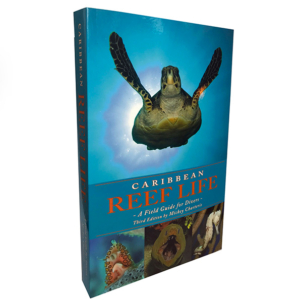
A fish identification book, however, can help the diving enthusiast in your look identify fish more easily. The Caribbean Reef Life book, for example, features colorful images and descriptions for countless fish, as well as other types of marine life, that inhabit the Caribbean Ocean.
Don’t wait until the last minute to find a holiday gift for the diving enthusiast in your life. Take action now to ensure that you’re able to find the perfect gift. Whether you choose a pair of waterproof socks, a diving mask defogger, a dive watch, an underwater camera, diving lessons, a dry bag or a fish identification book, the diving enthusiast is sure to appreciate any of these seven wonderful gift ideas.
Want to create your own custom dive logs? Contact us today to learn more about our custom dive logs.
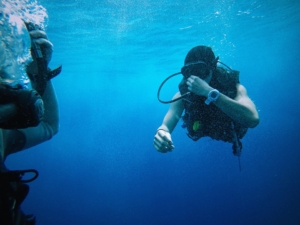
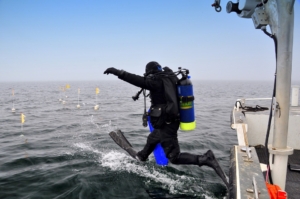 You’ll need to prepare all the necessary equipment for freshwater equipment. The good news is that freshwater diving — for the most part — requires all the same basic equipment as saltwater diving. This includes a diving mask, also known as a scuba mask, as well as fins, a diving suit, a breathing apparatus and a buoyancy control device (BCD). Check out
 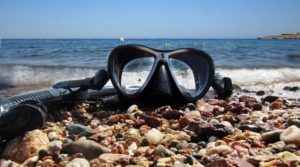 You’ll obviously need to pack a scuba mask for your next diving adventure. Some divers neglect to pack their own scuba mask, believing they can purchase a new one at their destination. While most beaches, as well as other diving destinations, have retail stores that sell masks, these aren’t high-quality masks. They are typically low-quality masks that fail to create a waterproof seal when worn.
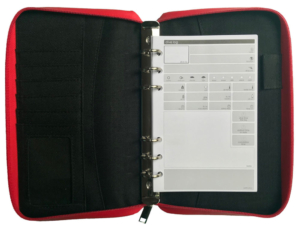 A
A  Why should you carry line cutters when diving? Well, there’s an unfortunate amount of debris littering the oceans. In addition to trash, you’ll probably discover fishing lines and nets floating about. If you happen to get tangled in a line or net, you may struggle to escape. Using a pair of line cutters, however, you can cut the line or net. Some divers carry a knife instead of line cutters, but line cutters are typically safer to use because of their enclosed design. They feature two blades that are shielded with plastic. To cut a line or net, simply place it through the narrow opening of the line cutters, at which point the two blades should cut through it.
 Keep your body relaxed when diving so that you don’t consume an excessive amount of air. Some divers are guilty of tensing their body. When your body is tense, however, your respiratory rate will increase, meaning you’ll consume more air. At the same time, tensing your body will restrict your ability to swim and navigate. It may take a little practice, but you must learn to relax your diving when diving. By keeping your body relaxed, you’ll be able to breathe and swim more efficiently, which may lower your risk of injury.
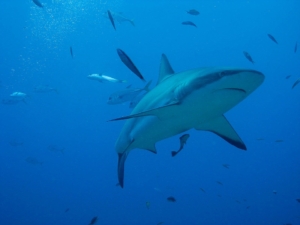 Contrary to the image portrayed in mainstream media, shark attacks on humans are pretty rare. According to
 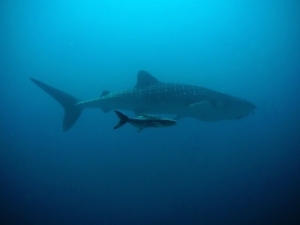 It’s perfectly fine, as well as safe, to dive with sharks — assuming you take a few basic safety precautions. As previously mentioned, shark attacks on humans are rare, with just 19 shark attacks occurring each year in the United States. With that said, shark attacks on humans can and do occur. Most attacks, however, are at least partly attributed to human neglect or error. By taking a few basic safety precautions, you can safely dive with sharks.
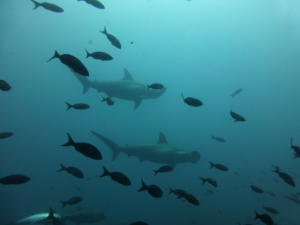 Before we reveal where to find hammerheads, let’s take a closer look at this majestic shark. Contrary to what some divers believe, the hammerhead isn’t a specific species of shark. Rather, the term “hammerhead” refers to any shark featuring a characteristically hammer-shaped head. Most hammerheads are in the Sphyrna genus, though some are categorized in a different genus. The winghead hammerhead, for example, is placed in the Eusphyra genus.
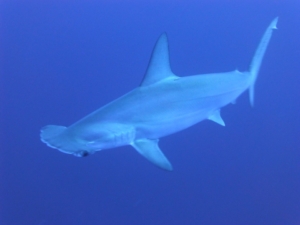 Although hammerheads are somewhat rare, you can still find them when diving — you just need to know where to look. Hammerheads thrive in warm and shallow coastal waters. You typically won’t find them far north or south, nor will you find them in hundreds or thousands of miles away from the coast. Rather, all nine species of hammerheads prefer warm and shallow coastal waters. So, if you’re hoping to encounter a hammerhead, you’ll need to choose a dive site that’s located in shallow, warm waters near a coast.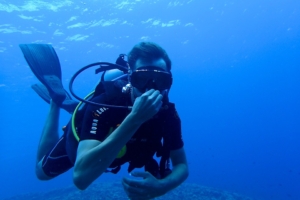
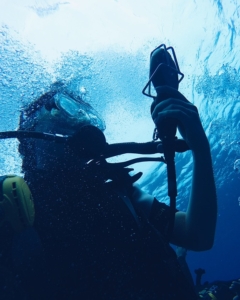 If you aren’t doing so already, you should start logging your dives. By completing a dive log for each of your dives, you’ll have a written record of your underwater experiences. You can then use this information to better prepare yourself for future dives. If you discovered that one gas tank was insufficient for a particular dive, for example, you may want to bring two gas tanks. Alternatively, if a dive log shows that a 3 mm wetsuit didn’t offer enough thermal protection, you’ll know to wear a thicker wetsuit, such as a 5 mm wetsuit, when diving in similar waters.
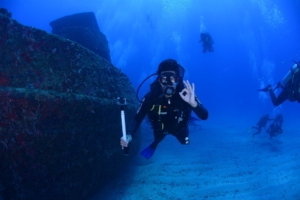 You’ll encounter a wide variety of marine life when diving, some of which may include fish, mollusks, turtles, squid, sharks, jellyfish, dolphins and even whales. Without a waterproof camera, though, you won’t be able to capture these moments on film. You can always make a written note of the marine life you enter when diving on a dive log, but there’s no substitution for capturing these memories on film.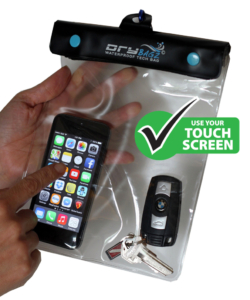
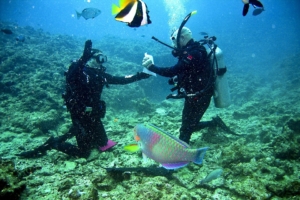
 Although it sounds like a meaningless skill, knowing how to communicate with other divers below the surface is important for several reasons. First, it allows you to convey potential hazards that could otherwise cause injury to either yourself or another diver. If you are running low on air, you can inform your buddy so that you can use his or her regulator. If you want to travel in a different direction, you can communicate this to your buddy so that he or she can follow you.
 While not as effective as hand signals or a dive slate, lights can also be used to communicate when diving. A dive light is a special type of handheld flashlight that’s designed to illuminate your surrounding environment when diving. If you’re diving at night, you can use a dive light to increase your visibility. But dive lights are also an effective means of underwater communication.
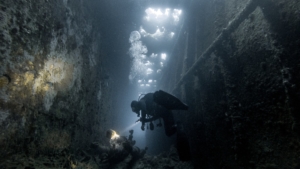 Recorded in most dive logs, bottom time refers to the total length of time a diver stays underwater. The Professional Association of Diving Instructors (PADI) defines the term “bottom time” as being the total elapsed time from descent to ascent. To calculate your bottom time, you count the minutes and seconds that you stay underwater, beginning from when you splash into the water and ending when you return to the surface.
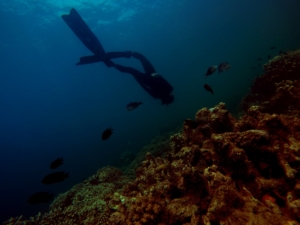 Another way to extend your bottom time is to use a buoyancy control device (BCD). Also known as a buoyancy compensator, this wearable device is designed to stabilize and control your body while underwater. There are different types of BCDs, though most models feature a hollow bladder that you can inflate or deflate. If you find yourself sinking, you can inflate it with additional gas. If you find yourself naturally floating towards the surface, you can deflate some of the gas from your BCD’s bladder.